INTERVIEW: Ikaros. University Of Applied Sciences Rosenheim Team (Rosenheim-Germany)
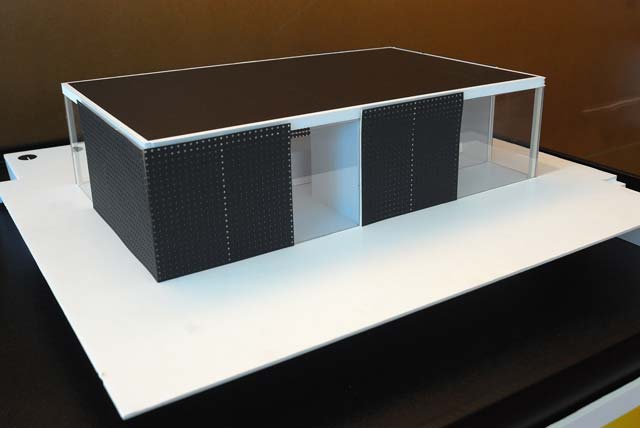
Madrid Solar 2010- Solar Decathlon Europe.
How many have you got in your team ?
We're 35 students.
Your average age ?
27 years.
What is the distribution of your gender ?
We're 7 women and 13 men .
What are your original subjects : architecture , electronics , computer science , ..... ?
Architecture , electrical engineers , computer science engineers , wood construction engineers , wood material engineers , commercial engineers.
The house you construct has been designed for the climate in Madrid ( Spain ) , but would its adaptation be simply possible to other climatic characteristics ( resistance to strong winds , hours of light , temperatures of environment , antiseismic preparation ..... ) ?
Our house isn't designed for the climate in Spain due to being the concept of a passive house ; this type of house adapts itself to any climate condition . Moreover , due to the fact that our construction is based on a concept of modules whose structures are corresponding to wooden frameworks , it is easily transportable and resistent to winds and seismic conditions . Our house fulfills the German construction norms ( norms
DIN ) for the calculation of the statics and loads in wood constructions ( DIN 1052 ) .
What sales price would this prototype have for the public ?
Our house - as prototype - costs 500.000 € and it costs 600.000 € with an additional terrace . But this only at the level of the prototype ; if this prototype would be destined to its production , the costs would reduce to half the amount , as to say , to 250.000 € .
Is this house presenting itself as a kit , being able to be set up or removable , or does it need a special human team to build it up in its final location.
A specialized personnel isn't needed for the construction and setting up of our house . Our own student team realizes the setting up of the house , and any person with a title as a carpenter , construction staff members , and electricians can carry out the setting up of the house as well .
What kind of total amount of energetic consumption / production ( and referring to m3 as well ) has the house got you're presenting ?
We're still inside the process of depuration ( purification ) . Due to that reason , we're unable to answer this question .
Number and typology of supported electrical household appliances ..... , f.e. how can someone dry his laundry ?
Our house has got all the conveniences of a house of European standard : heating system , kitchen , refrigerator , dishwasher , washing machine , dryer , coffee machine , plasma TV , audio system , and Internet .
Concerning the construction and installation of the house , what is the amount of emission of CO2 to the atmosphere ?
This question is covering many direct and indirect processes which we cannot calculate and where we would miss the true result , due to this reason , even if we would indicate the most approximated value as possible .
What kind of user profile is your creation aiming at ? Town people , rural people , young people , old people , number of habitants .... ?
This house is for a couple , and 2 guests ; in total for 4 persons . Due to the fact that the house is totally autarchic ( self-sufficient ) , it is producing more energy than it is consuming ; due to this reason , the house is totally independent of the electrical supply net , and it can be used in any location , as inside towns or also in rural regions . Because it is a house of one floor only , this means it can be used by people with physically limited abilities and persons of the third age .
Have criteria been considered for the accessibility for the communities of disabled persons there ?
Yes.
What type of materials does your construction prevail and contain : construction material ( brick and cement ) , wood , ceramics , natural stone , thin walls of cardboard and plaster .... ?
Wood , synthetic insulators , insulators of biological origin , plaster , cement , materials of natural origin .
Do you use some sort of process of the recuperation and portable water purification of rain water ?
No , but we're going to use the rain water for the cooling system which is helping the air conditioning system in its turn .
Is some kind of system , recycling waste materials , as development for biomass, biogas , etc . , presently implemented or anticipated ?
No.
From a technical or architectonic point of view : What kinds of improvements , concerning I+D , have you implemented in the development of the solar house ?
We wish to present an innovative system of façades which is corresponding to a system of lamellas containing solar plates .
What kinds of technical requisites are distinguishing your solar house from the rest of your competitors ?
We really don't know , due to the fact that we don't know any other existing prototypes in depth . For that reason it wouldn't be very serious
to answer your question without any basis .
Is your solar house 100% self-sufficient ? Does it need the electrical supply net for any kind of consumption ? In case of the opposite , what percentage of energetic self-sufficiency have you achieved during its development process ?
Yes , it's 100% self-sufficient , and we don't need electrical energy for its self-supply .
Apart from the Technical Codex of Construction , what kind of norm standard of study have you taken into consideration else during the construction process of your solar house ?
We don't work with the Spanish norm standard , but we work with the German norm standard due to the fact that our house will be presented at fairs in that according country subsequently , and later on it will be installed inside a residential park for its following use .
Starting from the point of differing between the value of construction and the value of the solar installation , how long is the solar installation going to need to amortize for the purchaser of a solar house ?
What would the amortization period be , counting with possible assistances and subventions ? - Due to the big support , which the German Government is annually inserting in the incentives for the use of renewable energies ( subvention for the installation of plates , which means that we can borrow from the banks at very low rates of interest ) in the installation of solar plates in the fields and inside the houses of private individuals in towns , and due to the good price , being paid for the electricity so that private individuals can be connected to the electrical supply net of the country , it is thought that the amortization period shouldn't be bigger than 10 years .
How many square meters has the roof of the solar house ?
70 m2.
Is it easy to design a solar house where the roof has a good orientation ( this said without lessening the design and elegance of a house , like f.e. with a roof of four sides ) ?
Due to the fact that our house is passive , meaning that our architecture and design is viewed with big and large windows at the southern side , the solar radiation is going to enter and heat our house this way , avoiding thus the loss of heat with a very good isolation . Moreover , our solar panels are established at the roof and aren't seen by the user , so that in our case the architecture is independent in its orientation towards the sun and also totally independent of the necessities of the photovoltaic system . We believe that we can achieve a big efficiency in the supply of electric energy with the new solar technology ; this said without lessening the architecture of the future houses using this system .

Relacionadas
Entrevista al Equipo de la Universidad de ciencias aplicadas de Stuttgart para Solar Decathlon 2010
Con motivo del seguimiento especial que desde nuestro medio llevamos a cabo de la competición interuniversitaria, nos complace ofrecer entrevista exclusiva del Equipo multidisciplinar de Stuttgart.

El Solar Decathlón de Madrid «es un ejercicio extraordinario que anuncia el futuro de lo que se tiene que hacer»
Solar Decathlon Europe se celebrará en Madrid del 18 al 27 de junio. Está organizada por el Ministerio de Vivienda, en colaboración con la Universidad Politécnica de Madrid y el apoyo del Departamento de Energía de Estados Unidos.

Gran Casa del Hermano : Solar Decathlon Madrid 2010
Seguimiento de la votación popular a la mejor casa del Solar Decathlon que se celebrará en Madrid el próximo mes de junio 2010.

Agenda
Semana Internacional de la Electrificación y la Descarbonización
- noviembre
- 24-26
09:00 / 20:00 horas