INTERVIEW: Urcomante Team (Valladolid-Spain)
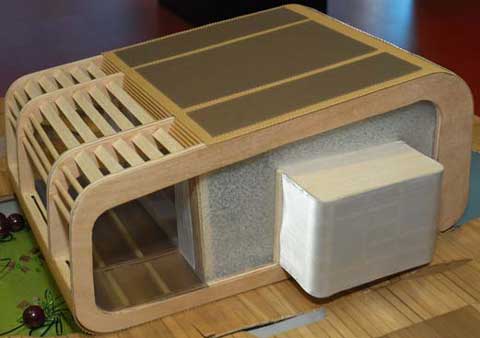
Madrid Solar 2010- Solar Decathlon Europe.
How many people on the team ?
Although there are currently 20 people who’ve been working on the project from day one, there have been nearly 100 students who’ve participated in some way with the execution of many of the duties carried out so far.
Middle Ages?
The majority of the team members involved with the project have just, if not already, completed their university studies therefore resulting in the average age being around 25 years old.
Gender distribution...
The distribution of sexes in the group is fairly balanced.
Studies of origin: architecture, electronics, computers ...
The team consists of varying disciplines and areas of study such as: industrial, telecommunications, electronic and mechanical engineering, political science, business administration, and of course, architecture.
The house you build, is designed for the climate in Madrid (Spain), but is easily adapted to other climatic characteristics (resistance to high winds, hours of light, temperature, seismic measures ...)?
The similarities between the climate of Madrid and Valladolid works to our benefit, therefore adapting our house to the climate and latitude settings needed for some of our equipment, such as the photovoltaic system, hasn’t been necessary. In addition, our house has the option to adjust the roof’s degree of inclination in order to capture more of the sun’s radiation and maximizing the efficiency of the system. The foundation is adaptable to the user depending on type of ground on which the house will be built and the mobility needs of the inhabitant.
What retail price can have this prototype?
We are providing different options for the house from which the inhabitant may choose. Depending on their technological demands, once the house is mass-produced, its price can range from 130,000 € for the basic model to 190,000 € for the “fully-loaded” model which will include all the technologies that we will present in the competition.
Kit "will be presented as detachable or you need a specific team to build on its final location?
We will always have the two options to choose from, however this particular house is designed to be built and taken apart in less than a week. Therefore, by having the majority of the materials prefabricated in workshops by our suppliers, this will simplify the building process as well as quality of the final product.
What is the relationship of energy production and consumption-per m3 is the home you build?
The projected energy to be generated annually is estimated to be around 10,500 Kwh at 875 Kwh per m3. Once the house reaches optimal self-sufficiency, we will have injected 6,000 Kwh back into the power-grid, resulting in annual earnings of around 2,000 € per year.
Number and type of appliances supported ... For example, how dry the clothes?
We have chosen the most efficient domestic appliances (refrigerator/freezer, washing machine, dryer, dishwasher, TV, DVD player, computer, oven and vitroceramic cooktop) possible for the house in order to obtain the highest score possible.
In the construction and installation what is the emission of CO2 into the atmosphere?
The idea behind the CO2 balance of the prototype is that the timber used for structure as well as the interior of the house will have captured the same amount of CO2 emissions during its lifecycle as will be produced during the construction phase, therefore bring the CO2 balance to zero.
What is thought profile your creation? "Urban, rural, young, old, number of occupants ...?
The name of our prototype is URCOMANTE, which is a word composed of the various individuals to whom the living spaces of the house can be adapted to(urbanite, cosmopolitan, manager, immigrant, and dilettante). The logic behind this idea is that there must be flexibility in terms of options for building the house as well providing the capacity for it to adapt to its occupants.
Criteria are referred to accessibility for disabled?
We have paid close attention to needs of the physically disabled to ensure that nothing may impede an inhabitant from using the house adequately. We have avoided the placement of stairs and narrow spaces to facilitate mobility throughout the house in addition to the integration of a programmable home automation system that can accommodate such a user with access to all the daily automated functions of the house as well as emergency services.
What kind of materials predominate and contains your construction: work (brick and cement), wood, ceramic, natural stone, plasterboard walls ...?
The single most predominant material in the house that can also be recognized for its ecological characteristics is ecologically certified timber because its local origins do not imply extra CO2 emissions during transport. In addition house will be insulated with material derived from sheep’s wool as this material has a higher sustainability factor than the conventional fiberglass insulation.
Do you use some sort of recovery-purification of rainwater
Yes, we intend on recycling both rainwater and the grey water for water supply and watering the garden respectively. By doing this, we can become more water independent and avoid the costly process of piping water in from distant sources.
Is this implemented or planned some form of recycling, and utilization for biomass, biogas ...?
All organic waste is to be recycled as compost for the plants that will be grown around our house.
From the architectural point of view or what technical improvements in R & D have implemented in the development of solar home?
We have sought to developed technologies in almost every field associated with the house in order to facilitate its use as well as to reduce the environmental impact and improve such aspects as spatial distribution, natural and artificial lighting, ventilation, security energy efficiency, insulation and acoustic conditioning, etc…
What are your technical requirements differ from other solar house competition?
The answer to that question can only be revealed at the end of the competition.
basis of differentiation between the value of the construction of the value of the solar How long the solar system would be recouped by the purchaser of a solar house? What would the recovery period taking into account possible grants and subsidies ...?
Regarding energy production, the amortization of the solar power system is estimated at about 2 years, depending on the situation. With the available premiums at the moment, the investment is said to amortize between 6 and 8 years once grid connection has been established, therefore providing us with 20 years of net gains.
How many square meters of rof solar home?
The rof of the house measures to about 60 m2.
The solar panels have "trackers?
No, only some of the panels on the house will be able to change their orientation accordingly in order to capture the most solar radiation during the summer and winter months.
Relacionadas
Las 20 maquetas de la competición Solar Decathlon Europe 2010, en la semana de la sostenibilidad de Rivas Vaciamadrid.
El próximo lunes 22 de junio a las 11:00 horas, se inaugurará el stand de SOLAR DECATHLON en el marco de la Semana de la Sostenibilidad de Rivas Vaciamadrid (Madrid).

Gran Casa del Hermano : Solar Decathlon Madrid 2010
Seguimiento de la votación popular a la mejor casa del Solar Decathlon que se celebrará en Madrid el próximo mes de junio 2010.

Entrevista a D. Javier Hernández y D. Héctor Otero, miembros de la Casa Solar Urcomante de la Universidad de Valladolid para el Solar Decathlon 2010.
Suelo Solar entrevista a D. Javier Hernández, y D. Héctor Otero, quienes nos muestran con todo detalle las características más relevantes de la Casa Solar que ha proyectado la Universidad de Valladolid.


Agenda
Semana Internacional de la Electrificación y la Descarbonización
- noviembre
- 24-26
09:00 / 20:00 horas